

When one visits a hospital, one is struck by the amount of hard work and intensity of effort a doctor puts into work. The purpose of this essay is to help software engineers understand that a career cannot be measured just by compensation, it is also measured by how much value one brings to society.
The demand-supply laws of economics dictate that everyone should seek to get the maximum wage that their skills can demand in the market. While this is an useful guide for starters and early in career employees, these laws are pretty useless after a couple of years at work. The problem is that economics fails to consider anything outside the marketplace as factors impacting the workplace. The field of behavioral economics have received many Nobel Prizes in recent years because it points out the lacunae in the current economic models.
To any employee, it is obvious that there are many emotional and mental factors at work that decide how you fit in the workplace. I cover that here:
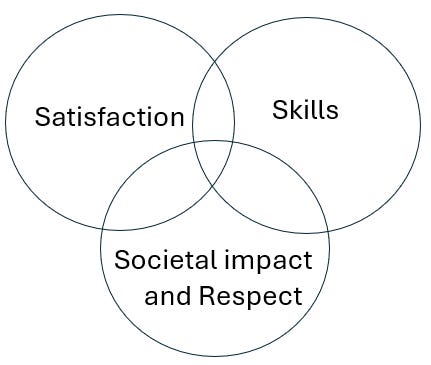
Everyone looks only at skills and the compensation one can charge for the skills. They forget the other pieces of a job - job satisfaction, societal impact and societal respect.
Doctors have it pretty rough. The more specialized doctors have to be on call 18-20 hours a day, 7 days a week, 365 days a year, throughout their working life. Long vacations are nearly impossible, as many patients keep falling seriously ill all the time. For a doctor, work is life and there is no talk of work-life balance. Doctors also face a race to upskill themselves to beat competition because there is a glut of doctors in the market. The period of residency is absolutely hell in a doctor's career where sometimes residents have to work for many days and nights without a break of even an hour. Such is their life. The wages are also paltry by Tech industry and software engineer standards. How come the doctors never complain?
The answer lies with doctors optimizing the other two aspects of their career - satisfaction and societal respect. The satisfaction of saving people's lives and making lives happier is immediate and tremendously fulfilling. This is something most software engineers will never understand. The societal respect for doctors is among the highest compared to all other jobs. Even for Steve Jobs in his last decade, doctors at Stanford meant more than any software engineer. Software engineers are disposable, not doctors. Software engineers are minions and mercenaries, doing any work for money, not doctors.
Software engineers are ready to disrupt any industry by automating them out of existence. They seem ready to make enemies of everyone outside their job family. Software engineers at Amazon were more than happy to automate all the mom and pop stores in the US out of existence. Did they ever think about the repercussions of their mercenary actions? Nope, they do not care. One does not ask questions when they are paid a lot. The mistake the engineers made was thinking that the high salaries are eternal. The truth is that henchmen are paid to do the hatchet job only for that short period. This is the instability faced by all mercenary in their life.
I argue that part of the existential crisis faced by Software engineers in the days of AI automation is the lack of focus on job satisfaction and impact on society. It is possible to lead a more fulfilling and happy life, if the focus shifts away from money and towards other factors. A life of balance will enable the inner flame of interest and enthusiasm to last longer instead of sacrificing all of it in the altars of Mammon. I always share the example of a candle with students. If one burns the candle at one end, it will last longer than if you burn it at both ends. Take care of your health, family, society and the self in addition to making money. Only then can one have a long career in this fast changing world.
Original link : https://www.linkedin.com/pulse/doctors-vs-software-engineers-vinod-aravindakshan-krnoc/